
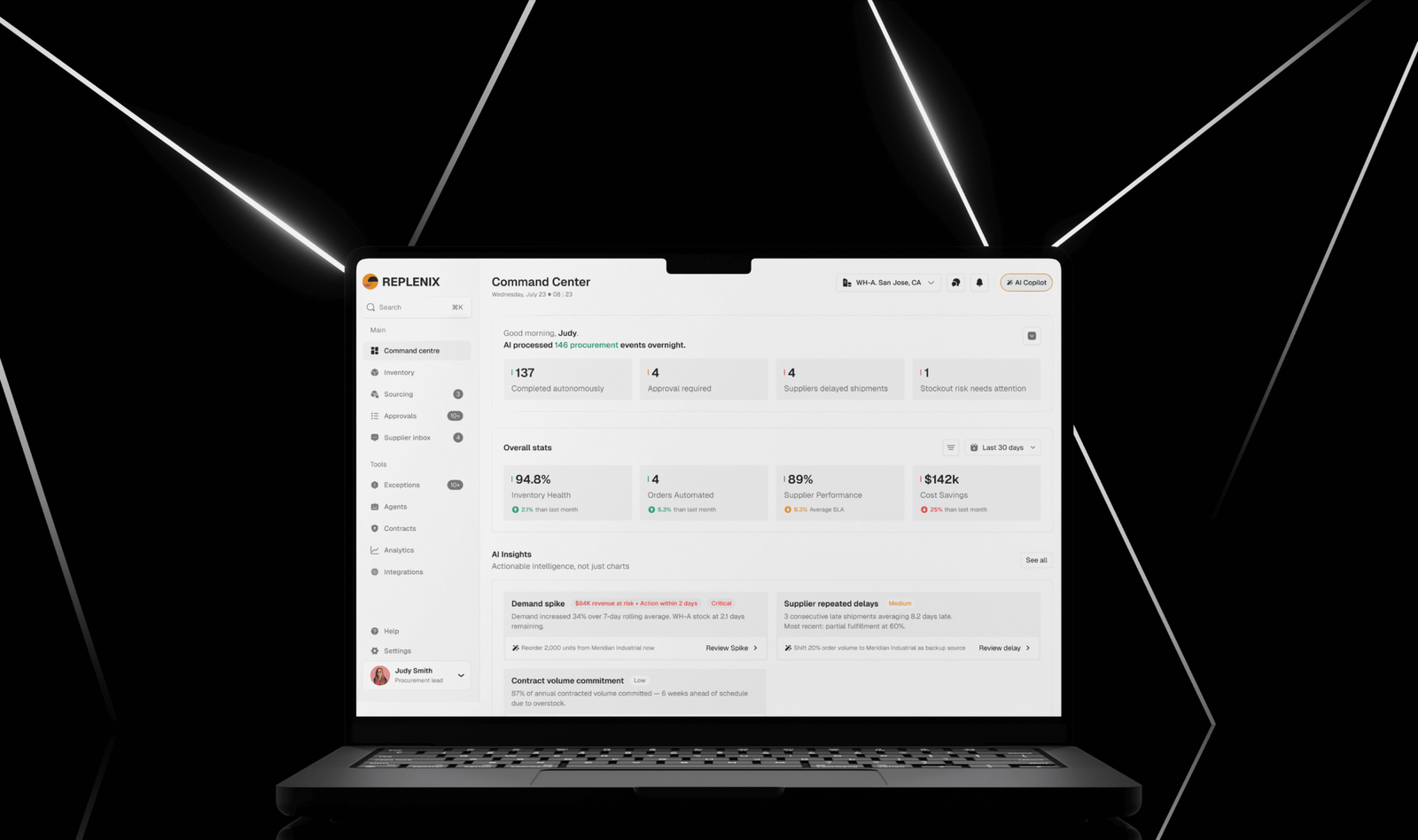
Replenix is an intelligent procurement and inventory operations platform that helps teams detect inventory risks, evaluate and manage suppliers, automate routine purchasing decisions, manage approvals and resolve operational exceptions from one connected workspace.
I led the end-to-end product design, transforming fragmented procurement processes into an AI-assisted decision system that gives teams the context, recommendations, and controls they need to act confidently.
PS: This project has been renamed and a lot of features like Messaging (Instead of fragmented slack, email and other platforms checkin), AI agents, Analytics, contracts, integrations & sub pages of features have been removed for Non disclosure purposes. Howver, it’s still filled with my approach, design choices, impact and some designs. Have fun! 🤩
Impact
Within the first six months of operation, Replenix delivered:
* 64% faster supplier comparison
* 68% faster identification of critical inventory risks
* 56% faster approval decisions
* 43% reduction in emergency purchase orders
* 83% fewer workflow context switches
* 31% improvement in contract compliance
Project Overview
The Problem: Climate risk data (floods, wildfires, heatwaves) is notoriously complex, fragmented across government sources, and difficult for the average homebuyer to interpret.
Product: B2B SaaS procurement and inventory platform
Timeline: 7 Months
Team: Product manager, 5 engineers, data scientist, procurement specialist
Responsibilities: Research, product strategy, information architecture, user flows, interaction design, prototyping, usability testing, design system and product analytics
The Problem
Procurement teams were making critical decisions across inventory system managing inventory risks, supplier quotations, approvals, contracts, and communication across spreadsheets, email, enterprise resource planning systems, and messaging tools.
This created three major problems:
- Inventory risks were discovered too late.
- Procurement decisions took too long.
- Teams could not easily understand or trust AI recommendations.
A single replenishment decision could require switching between six different tools and manually collecting information from several stakeholders. The challenge was not simply bringing all the data into one dashboard, it was helping users reduce the fragemented workflow and have answers to questions like:
- What happens next?
- What requires attention?
- Why it matters?
- What action is recommended?
- What evidence supports the recommendation?
- Who needs to approve it?
The Opportunity
I saw an opportunity to move Replenix beyond being another procurement dashboard to organising the product around data and modules, I organised it around the decisions procurement teams make every day.
AI handles repetitive analysis, monitoring and preparation and Humans remain responsible when decisions carry financial, supplier, contractual or operational risk.
Understanding the Users
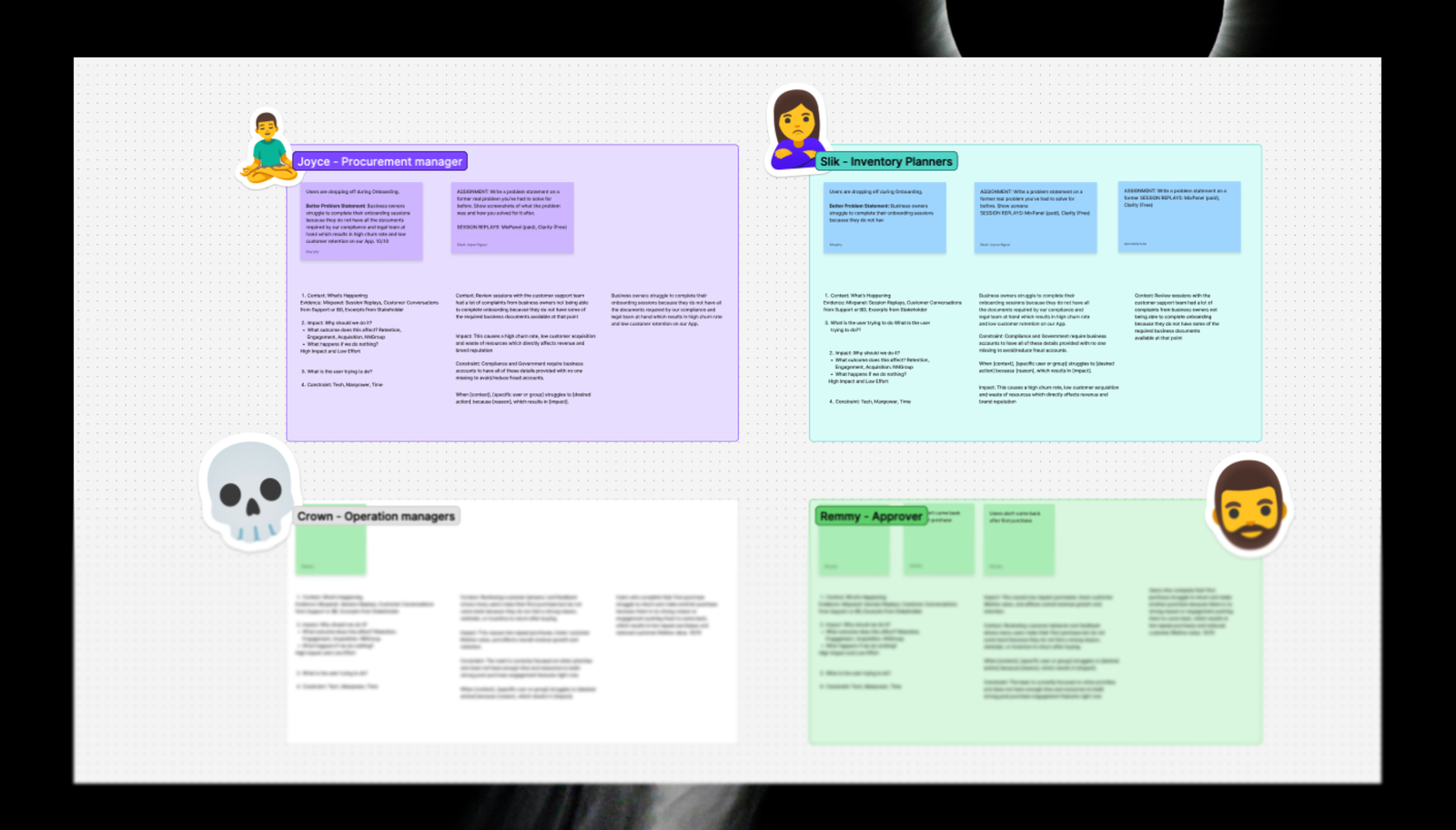
I worked with four primary user groups.
Procurement managers
Needed to find suppliers, compare quotations, negotiate terms, and recommend the best option.
Inventory planners
Needed to identify products at risk of running out and determine when replenishment should begin.
Operations managers
Needed visibility into exceptions, supplier performance, delayed orders, and unresolved risks.
Approvers
Needed enough financial, operational, and contractual context to approve purchases confidently.
Across all four groups, the most common problem was not a lack of data. It was the amount of time required to turn that data into a decision.
Designing for Decisions, not Dashboards
Key UX challenges emerged from the project
1. Prioritise decisions, not data
Instead of designing another analytics dashboard, I structured Replenix around the decisions users needed to make.
Every critical workflow answers:
- What happened?
- Why does it matter?
- What is recommended?
- How confident is the recommendation?
- What should the user do next?
2. Keep humans in control
AI agents could analyse data, identify risks, recommend suppliers, and prepare communication.
However, users could always inspect the evidence, change a recommendation, pause an agent, or require human approval.
3. Connect the full workflow
Inventory, sourcing, approvals, supplier communication, contracts, and exceptions were designed as one connected system.
Users no longer had to rebuild context each time a task moved between teams.

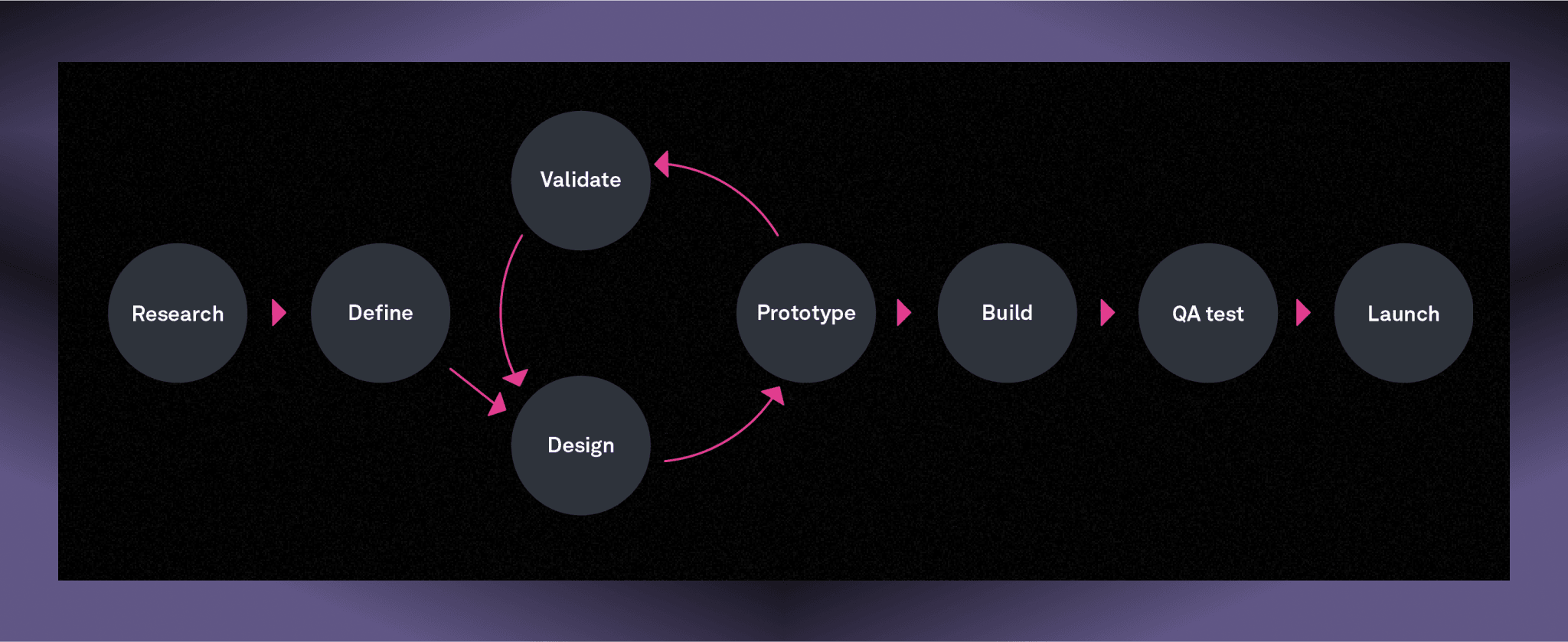
Design process
CONSISTENCY IS UNIQUE
A Resuable Design System
As the product evolved, I identified a pattern shared across Inventory, Sourcing, Approvals and Exceptions.
I formalised it as the Decision Panel.
Every consequential workflow follows the same structure:
Context → Urgency → Impact → AI rationale → Recommendation → Evidence → Alternatives → Accountability → Action
This reduced relearning across the platform and allowed new procurement workflows to inherit an established interaction model.
It also gave AI a consistent role across Replenix.
AI does not simply generate content.
It:
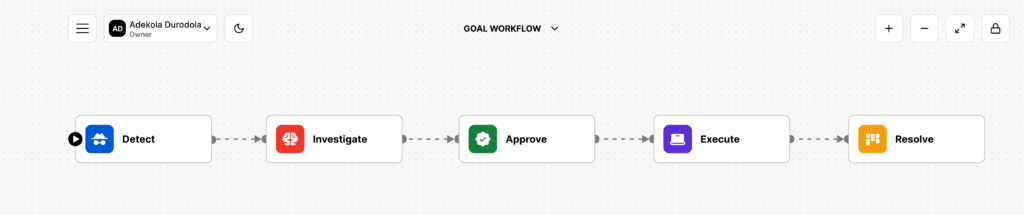
detects → explains → recommends → acts within policy → escalates when human judgement is required
SOLUTIONS
Command Center
Turning operational data into an action queue
The challenge
Procurement leads needed visibility across inventory, suppliers, approvals and exceptions and a conventional dashboard could show performance, but it still required users to work out what deserved attention first and start asking questions like:
“What should I deal with first?”
The Solution
I designed the Command Center around attention management rather than reporting.
Inventory risks, supplier delays and approvals are connected directly to their next action. Replenix summarises what AI completed autonomously overnight, separates those actions from work requiring human attention, and surfaces the highest-impact inventory, supplier and approval risks.
Design Decisions:
Prioritise decisions above analytics: Instead of asking users to interpret several charts, the interface surfaces: Inventory risks, supplier delays and approvals are connected directly to their next action.
- What changed
- Business impact
- Urgency
- Recommended action
- Ownership
Analytics remain available as supporting evidence.
Why it worked
Procurement leads could move from monitoring the operation to acting on it without navigating multiple modules first.Inventory risks, supplier delays and approvals are connected directly to their next action.
Measured impact
- 68% faster identification of critical procurement risks
- 137 procurement events completed autonomously overnight
- $142K cost savings captured
Analytics remain available as supporting evidence.
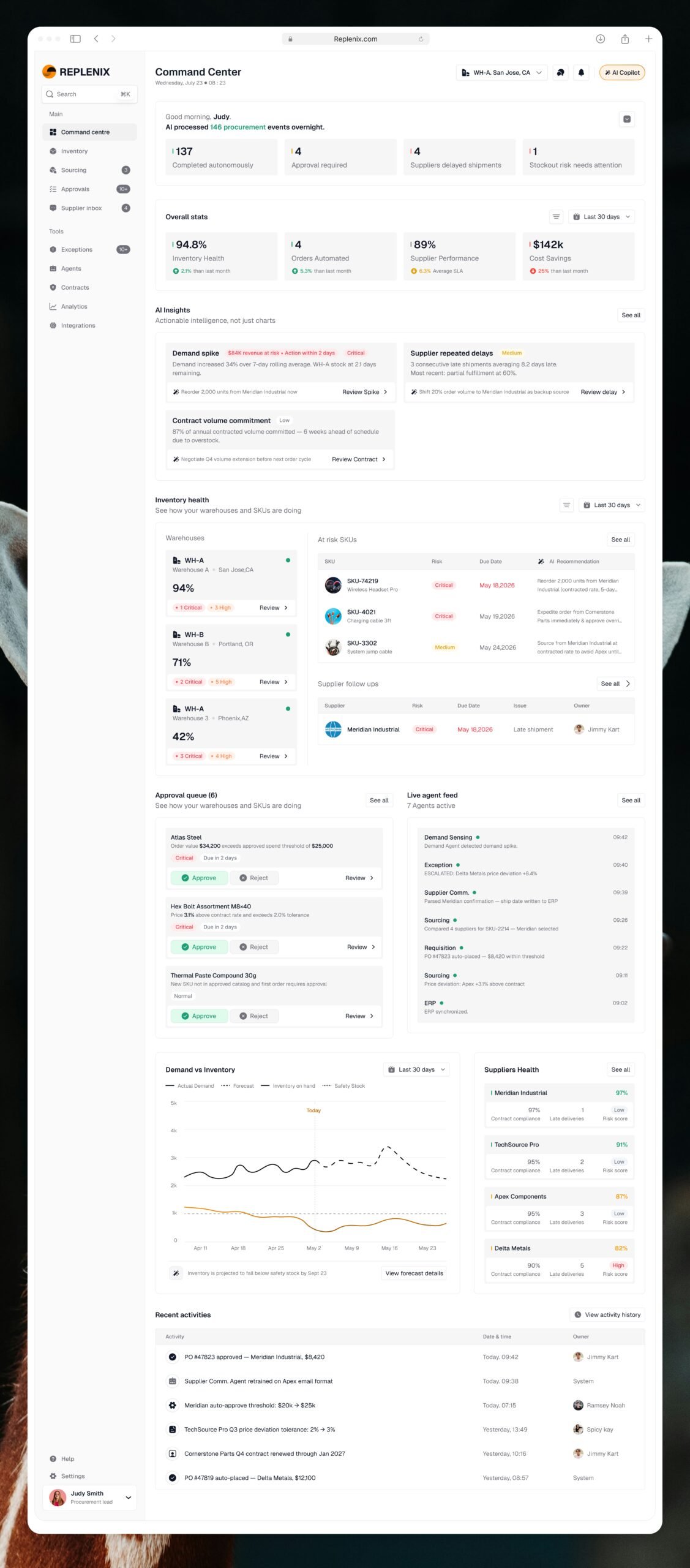
The Command Center separates work already handled by AI from decisions that still require human attention, allowing procurement leads to prioritise risk by impact and urgency.
Inventory Intelligence
Moving from stock visibility to proactive replenishment
The challenge
Seeing that 1,240 units remain does not tell an inventory planner whether the stock position is healthy and the demand velocity, warehouse distribution, supplier lead time and forecasted consumption determine whether action is actually required.
The Solution
I combined live inventory, forecast signals and warehouse health into an exception-led inventory workspace, Instead of making planners interpret every SKU, Replenix detects inventory risks and surfaces:
- Demand movement
- Current stock
- Risk level
- Time remaining
- Recommended action
Selecting a SKU opens a contextual Decision Panel with the evidence needed to act without leaving the inventory workflow.
Design Decisions:
I translated raw inventory values into operational consequences. The workflow becomes:
Demand change → inventory coverage → intervention deadline → recommended action
I also exposed warehouse-level stock so Replenix can consider redistribution before automatically creating additional purchases.
Why it worked
Planners could identify why a SKU was at risk and move directly into replenishment or alternative sourcing without rebuilding the analysis elsewhere.
Measured impact
- 96% forecast accuracy
- 1,248 SKUs continuously monitored
The key workflow metric was: Time from risk detection to replenishment action
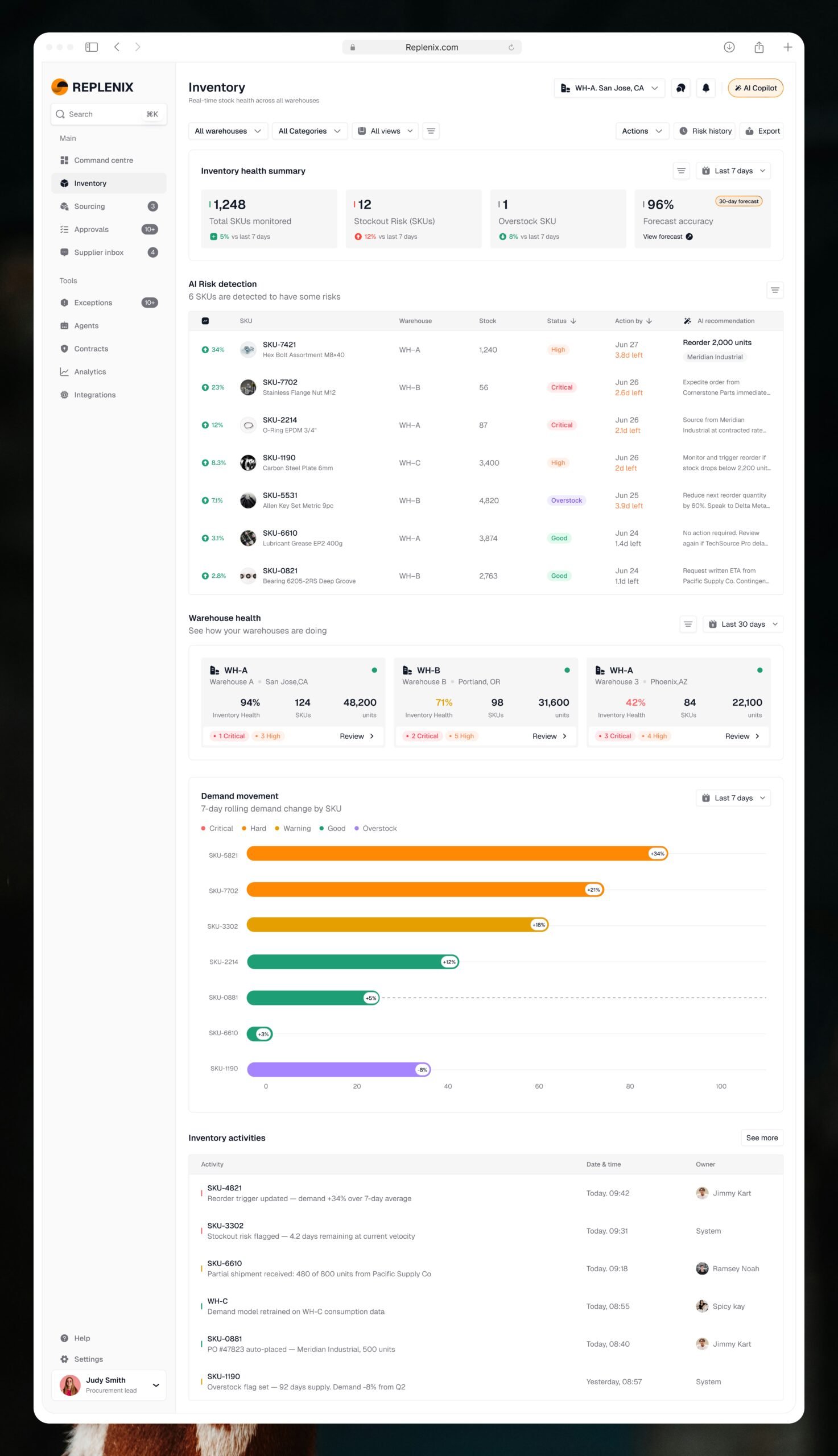
Inventory risks are surfaced before they become stockouts, combining demand movement, available stock and intervention deadlines into an actionable risk queue.
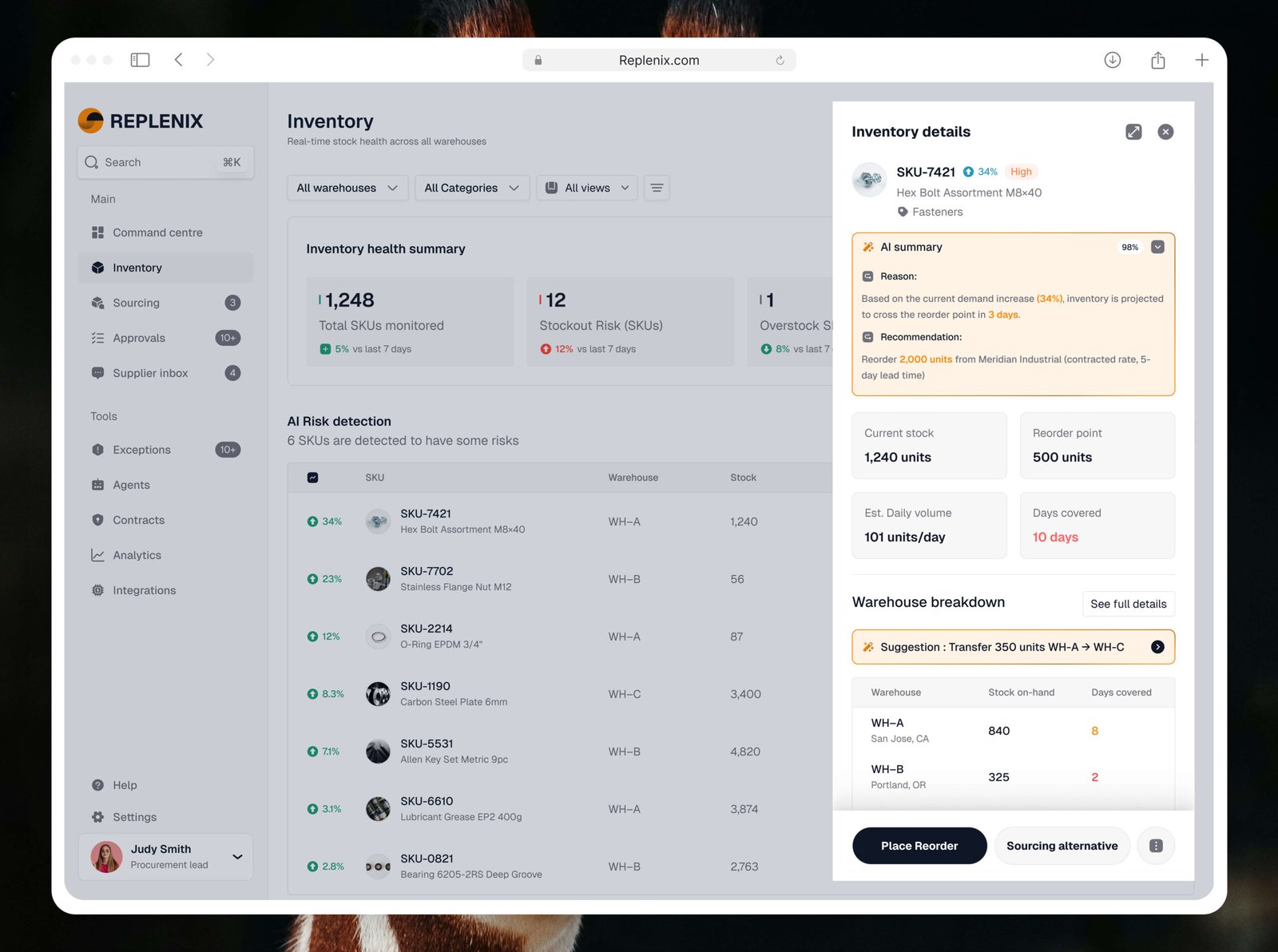
The Inventory Decision Panel explains why the SKU was flagged, shows inventory distribution across warehouses and recommends the next replenishment action without removing the user from their current workflow.
Contract-Bound Sourcing
Reducing sourcing time without bypassing procurement policy
The challenge
The cheapest supplier was not always the best procurement decision and cost needed to be evaluated alongside:
- Contract coverage
- Delivery capability
- Reliability
- Supplier risk
- Inventory urgency
Fully autonomous supplier selection also introduced governance concerns.
The Solution
I designed sourcing as a contract-aware decision system. When inventory creates a supply requirement, Replenix evaluates qualified suppliers, compares their operational and commercial performance, and recommends the strongest overall option. Out-of-contract suppliers can remain visible for benchmarking, but actions outside purchasing policy require human intervention.
Design Decisions:
I separated recommendation from authority. Built this page in a way so that AI can identify the strongest supplier, Policy determines whether it can act or not and then Humans intervene when the recommendation falls outside established thresholds.
This created a simple model:
AI recommends → policy validates → human intervenes when necessary
Why it worked
Buyers could evaluate suppliers using consistent criteria and move from supply gap to purchase decision without manually combining inventory, supplier and contract information.
Measured impact
- 64% reduction in sourcing decision time
- 62% contract-covered recommendations
- $1.24M identified sourcing savings opportunity
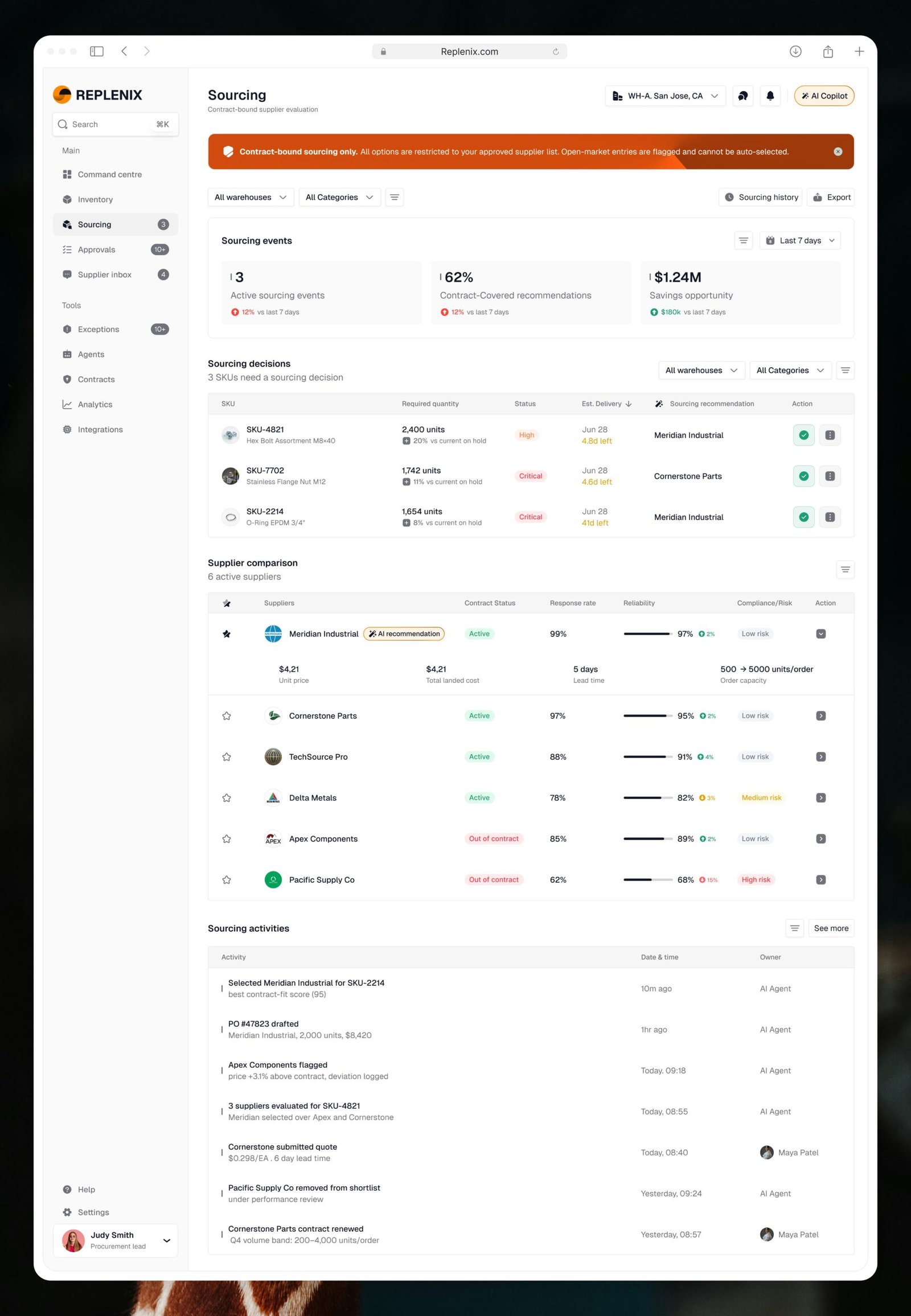
Contract-aware sourcing compares qualified suppliers across reliability, contractual coverage and operational risk while keeping AI recommendations inside established procurement policy.
One decision, complete context
The panel connects the inventory requirement, supply gap, supplier recommendation and contract evidence before asking the buyer to approve the purchase.
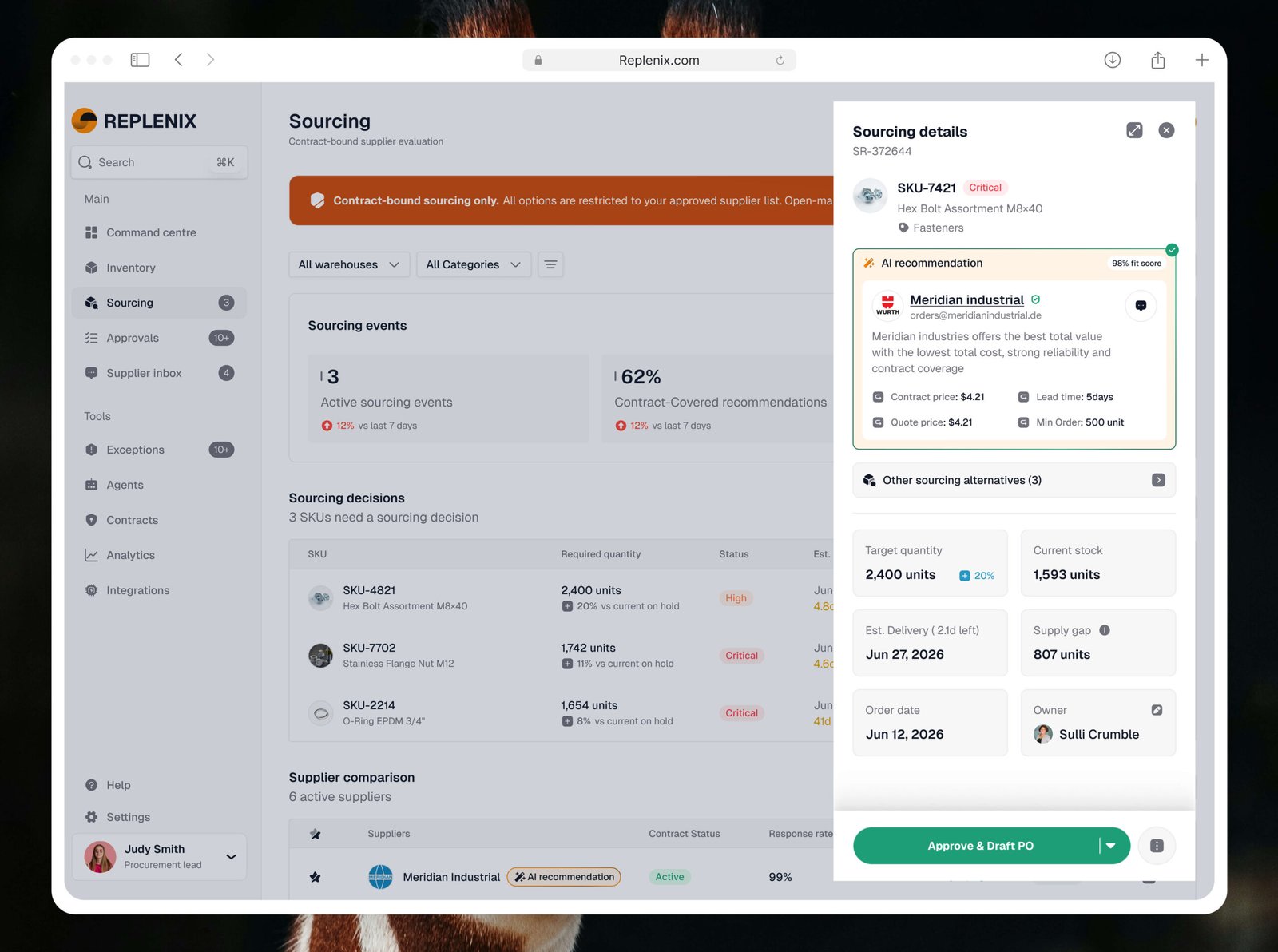
The Sourcing Decision Panel brings the supply requirement, recommended supplier, contract terms and alternatives into one review surface before a purchase order is created.
Approval Intelligence
Giving approvers the decision, not another request to investigate
The challenge
Approvers were receiving purchase requests without enough information to understand:
- Why the purchase was required
- Why a supplier was selected
- Whether the price complied with contract terms
- What would happen if they delayed or approved the request
The result was additional investigation and unnecessary back-and-forth.
The Solution
I redesigned approvals around decision completeness. The Approval Queue provides a prioritised overview of pending requests, urgency, financial value, SLA and risk and opening a request creates a contextual approval experience where the evidence changes according to the decision type.
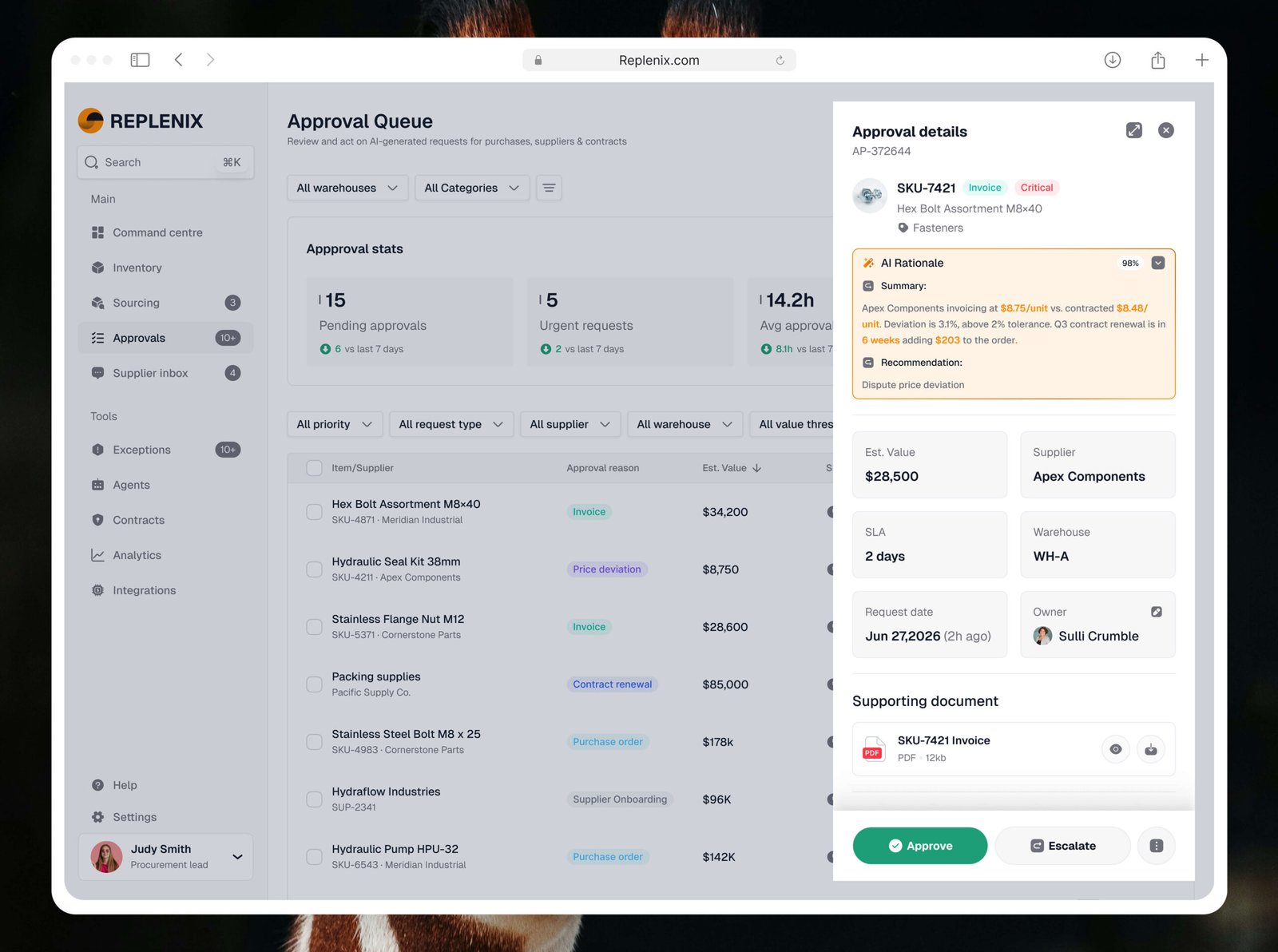
An invoice deviation emphasises:
Invoice price vs contracted price
A replenishment purchase order emphasises:
Forecasted demand, inventory risk, supplier reliability and concentration risk
Design Decisions:
Instead of creating one generic approval form, I made the decision context adaptive, the interface answers three questions before presenting the action:
- Why am I seeing this?
- What happens if I approve it?
- What evidence supports the recommendation?
Routine purchases that remain inside policy can be automated and high-value, high-risk and exception-driven decisions remain human-controlled.
Why it worked
Approvers no longer needed to reconstruct procurement history before understanding the request and the interface presented the decision and its consequence together.
Measured impact
- 14.2h average approval time
- 54 policy-compliant requests automatically approved during the measured period
- Approval requests returned for missing context
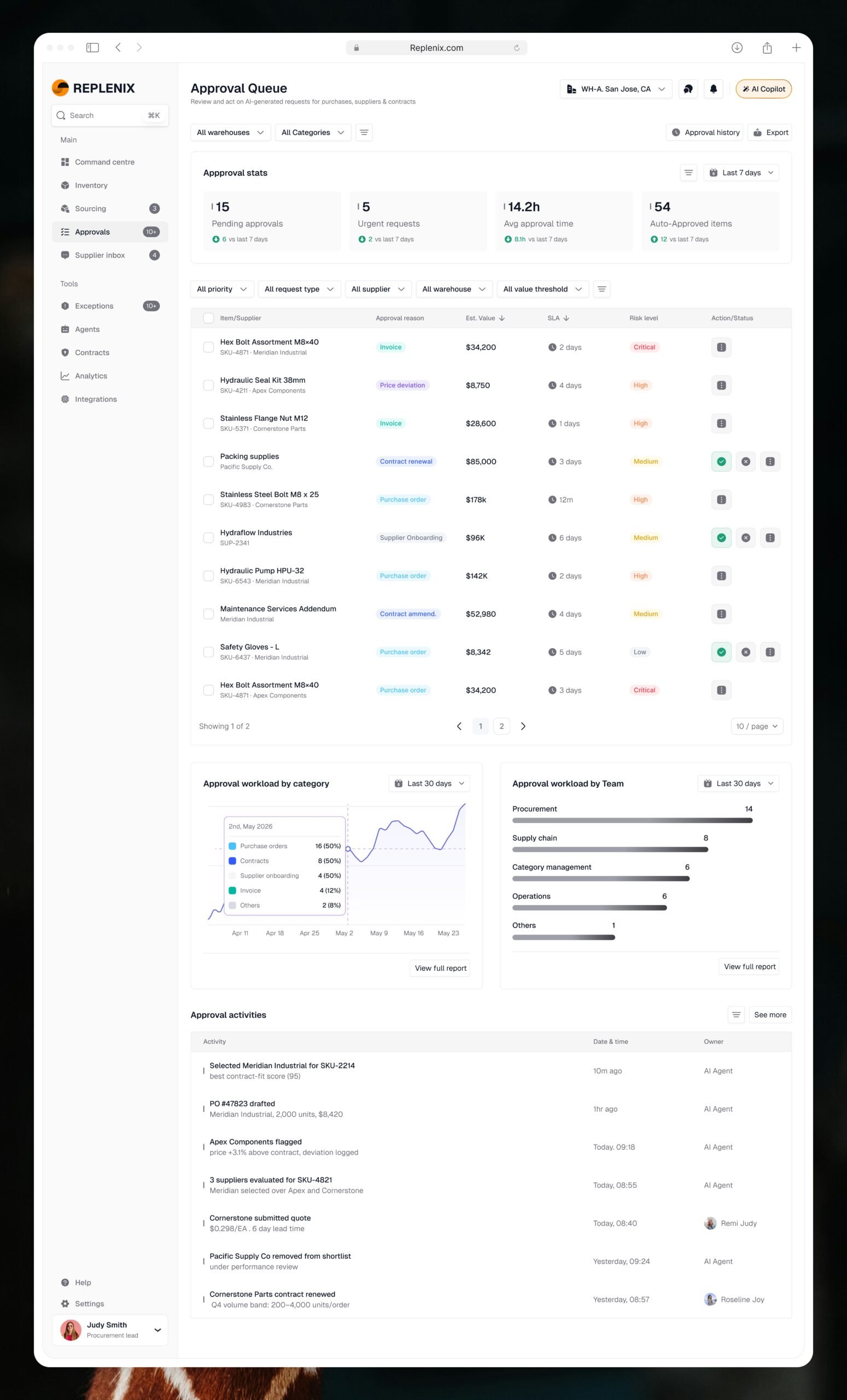
The Approval Queue prioritises procurement decisions by risk, value and SLA while separating work that requires human judgement from policy-compliant automation.
One approval pattern, different decision evidence
The panel connects the inventory requirement, supply gap, supplier recommendation and contract evidence before asking the buyer to approve the purchase.
Invoice exception: Focuses the approver on price deviation and contractual compliance.
Replenishment purchase: Focuses the approver on inventory need, supplier fit and operational risk.
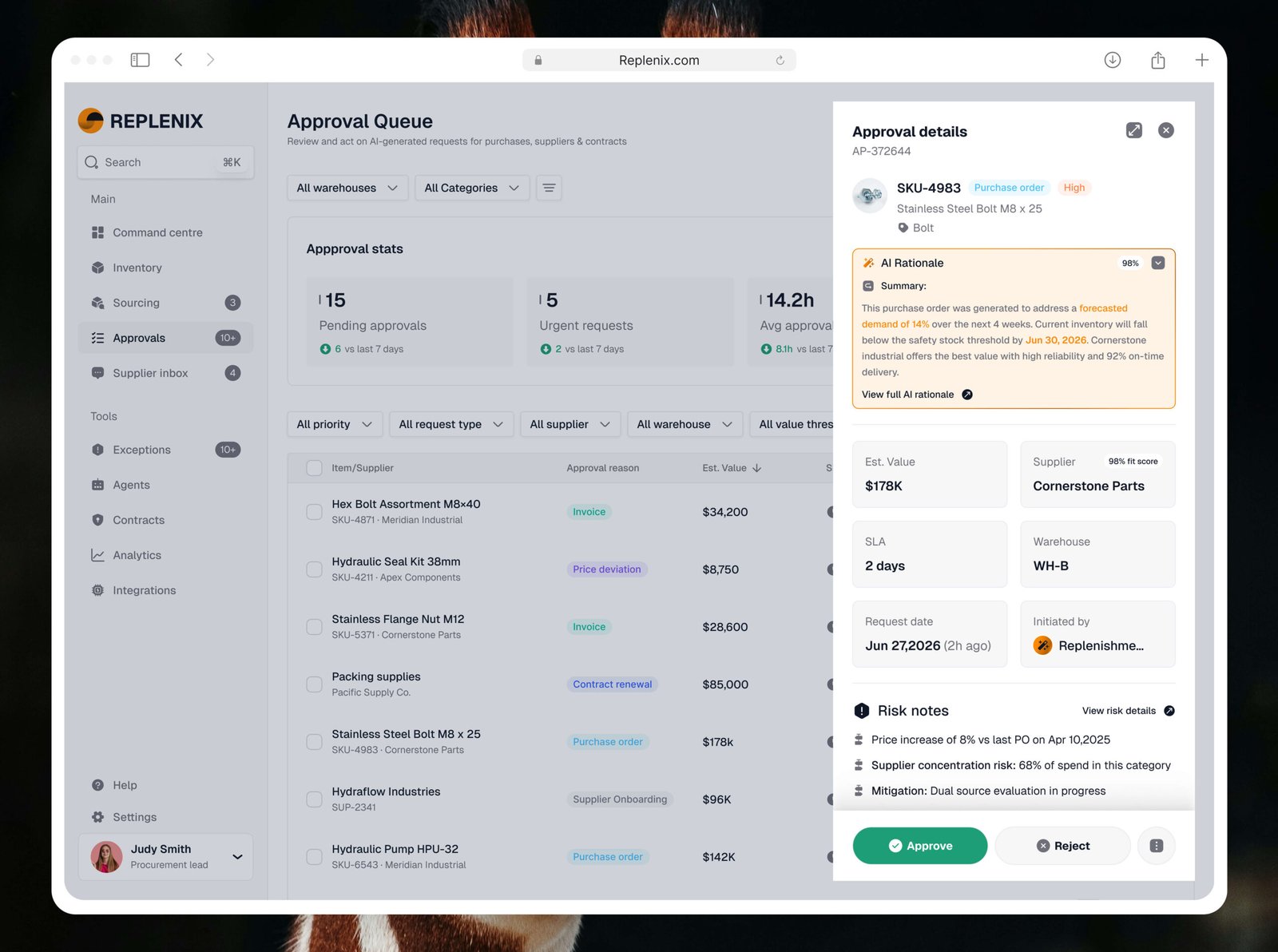
Approval evidence adapts to the decision. Invoice exceptions emphasise contractual deviation, while replenishment purchases expose demand, supplier and risk signals before approval.
Supplier Inbox
Turning supplier communication into procurement action
The challenge
Important supplier updates often arrived through email while the information required to evaluate them lived inside purchase orders, inventory systems and contracts. A message like this is not enough to make a decision:
“The shipment will arrive two days late.”
The buyer needs to know:
- Which order?
- Which SKU?
- What inventory does it affect?
- Can the delay be accepted?
The Solution
I designed Supplier Inbox as an operational communication workspace rather than a traditional mailbox. Every conversation remains connected to its procurement context.
AI Extracts:
- Supplier
- Affected order
- New ETA
- Cause
- Required action
Design Decisions:
I embedded AI summarisation and actions directly where communication happens. Instead of forcing users into a separate AI Copilot experience, Replenix brings intelligence into the workflow that needs it.
Why it worked
Supplier messages became actionable procurement events rather than disconnected conversations that had to be interpreted elsewhere.
Measured impact
- 92% supplier response SLA
- Time from supplier update to operational decision
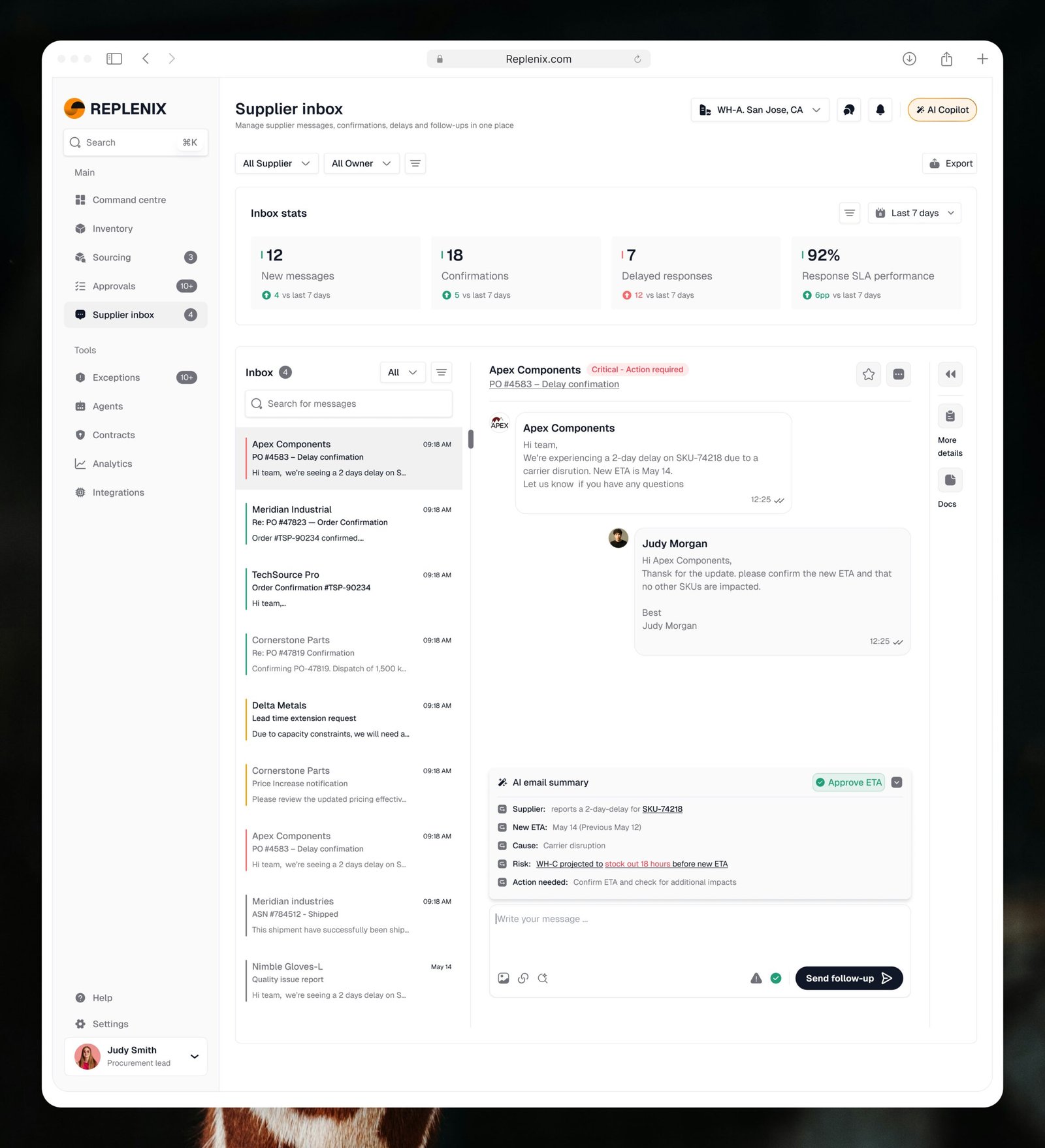
Supplier Inbox connects conversations to their operational context, allowing AI to extract changes such as delivery delays and turn them directly into reviewable procurement actions.
Exception Resolution
Turning system anomalies into business decisions
The challenge
Procurement exceptions were appearing across different parts of the operation:
- Price deviations
- Demand spikes
- Supplier delays
- Duplicate orders
- Contract violations
- Inventory shortages
Severity alone was not enough to prioritise them, teams needed to understand:
What happened, what is the consequence, who owns it and what should happen next?
The Solution
I created a central Exception Resolution workspace where issues are automatically detected, classified and assigned, and the queue supports triage by:
- Exception type
- SupplierOwner
- Severity
- Due date
- Status
Opening an exception transforms the anomaly into a decision. For example, instead of showing only:
18.7% price deviation
Replenix translates the issue into:
$4,620 potential overcharge if paid at the new rate.
AI then recommends resolution options based on the contract and procurement context.
Design Decisions:
I made business consequence the primary information, not the system error so that users should not need to calculate what a deviation means before deciding whether it matters.
Why it worked
Operations teams could prioritise exceptions according to actual impact and resolve them from the same context in which they were investigated.
Measured impact
- 14.8h mean exception resolution time
- The product currently monitors: 67 active exceptions
- Supporting metric: Percentage of exceptions resolved within SLA
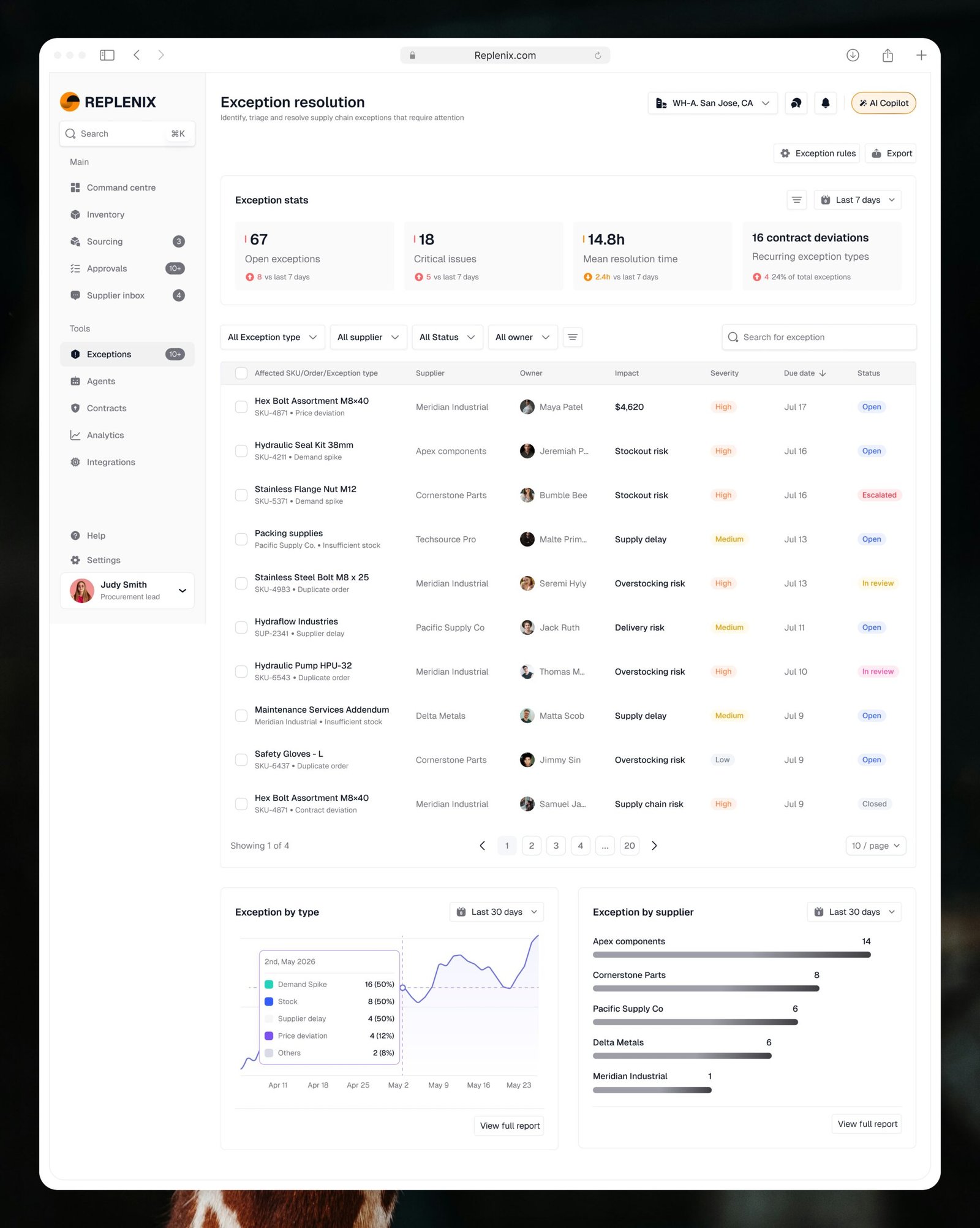
Exception Resolution centralises procurement anomalies into an accountable triage workflow, making ownership, severity and recurring supplier issues visible in one place.
Translate anomalies into consequences
18.7% deviation is system information.
$4,620 potential overcharge is decision information.
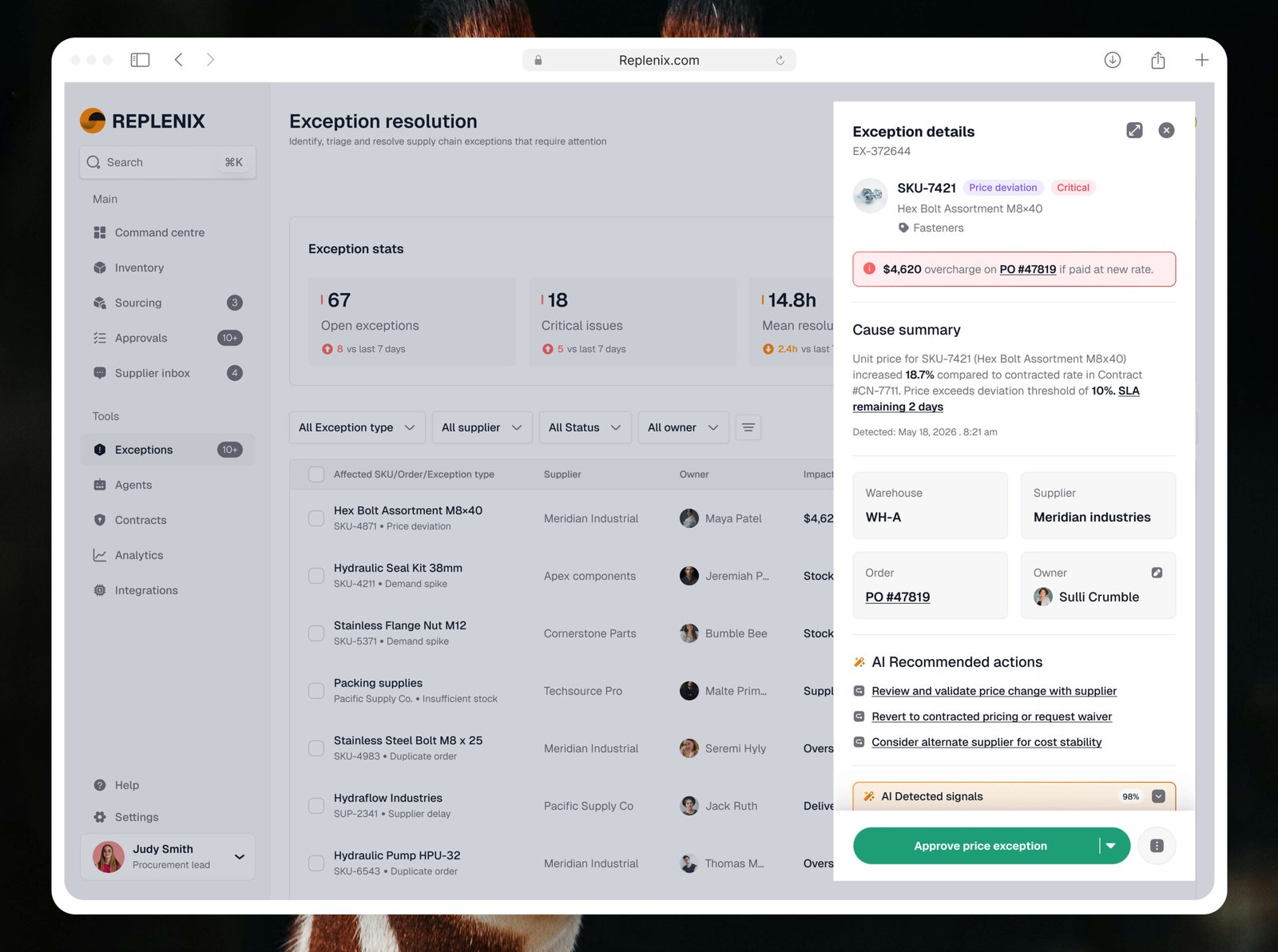
The Exception Decision Panel translates a contract deviation into its financial consequence, explains the cause and provides AI-assisted resolution options.
Human Control in an Agentic Product
A major product decision was determining when Replenix should act autonomously and when a person should remain involved.
Fully manual procurement would limit the value of automation and fully autonomous purchasing would create financial, operational and governance risk.. So I decied to introduce three levels of autonomy which allowed automation to scale without making the decision-making process opaque:
Automate
Routine, low-risk actions inside established policy.
Example: A low-value replenishment from a contracted supplier within approved price and quantity thresholds.
Escalate
High-risk, low-confidence or policy-breaking decisions require explicit human intervention.
Example: A supplier invoice exceeding contracted pricing or an out-of-contract purchase.
Recommend
The system prepares a decision and supporting evidence for human review.
Example: Selecting between qualified suppliers with different cost and reliability trade-offs.
This model allowed the product to gain efficiency from automation without making accountability unclear.
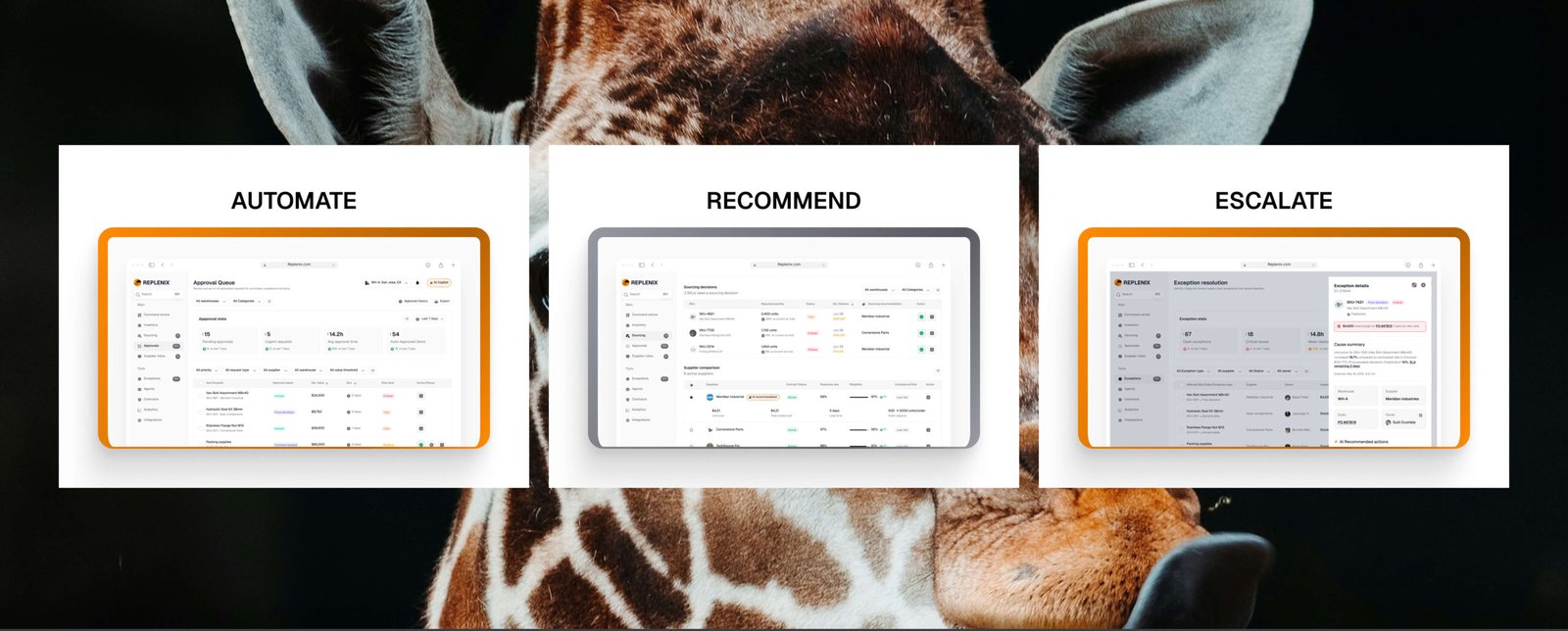
Replenix adjusts AI autonomy according to operational risk, policy and decision consequence rather than treating every procurement action equally.
Supporting Product Areas
Agents
A control centre for monitoring AI agents, their active tasks, decision history and human intervention requirements.
Contracts
Centralises supplier agreements, pricing, volume commitments, renewal dates and compliance rules used across sourcing and approvals.
Analytics
Provides deeper procurement, supplier, inventory and automation performance analysis beyond the operational dashboards.
Integrations
Connects Replenix with ERP, warehouse, finance, supplier and communication systems so decisions are based on current operational data.
These areas support the core workflow but were intentionally kept outside this case study to keep the story focused on the primary procurement journey.
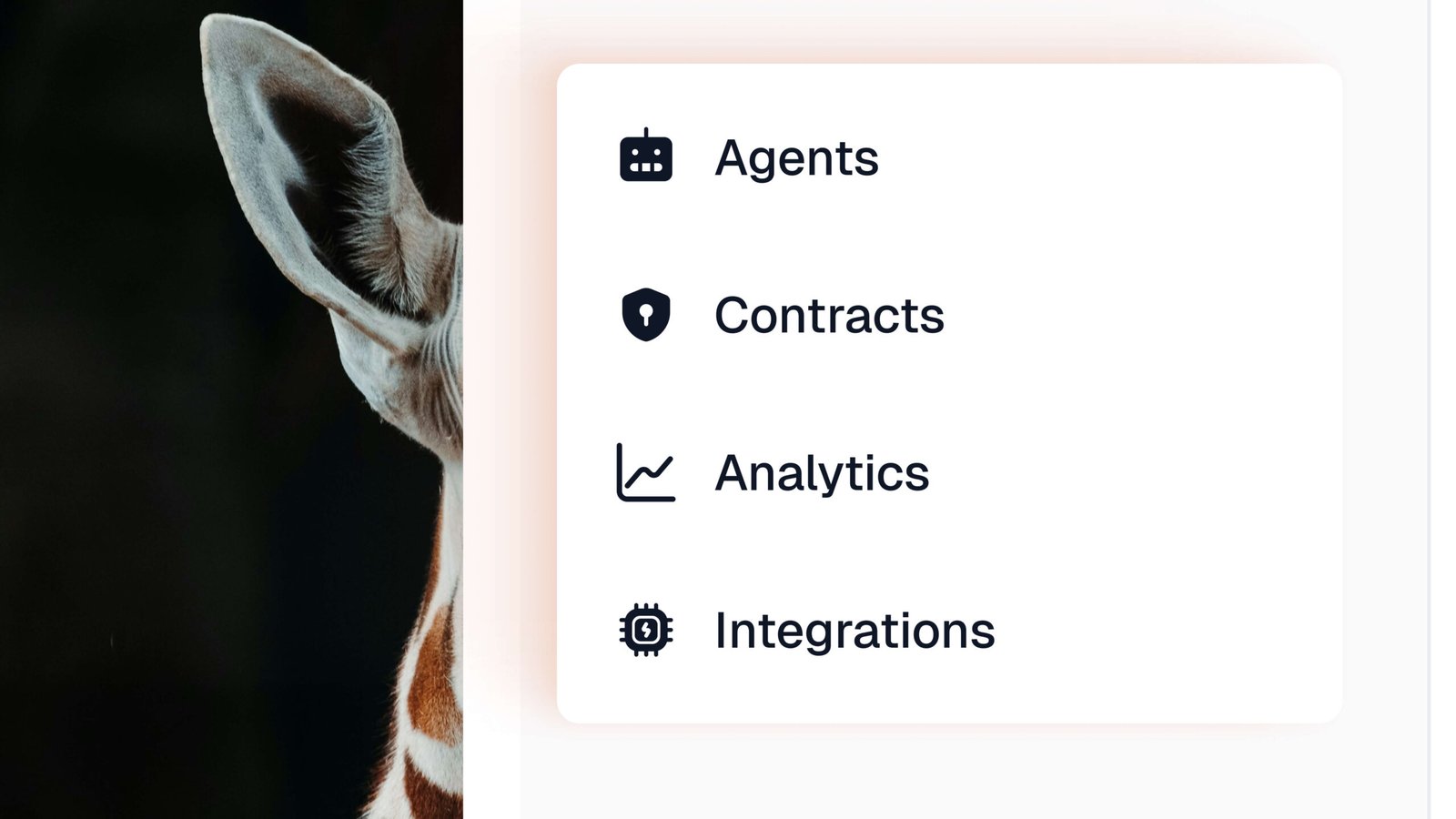
Supporting systems provide the intelligence, governance and operational connectivity behind the primary procurement journey.
Product Outcomes
Replenix currently provides a single operational layer across inventory, sourcing, approvals, supplier communication and exception management.
Live product signals include:
- 94.8% inventory health
- 96% forecast accuracy
- 92% supplier response SLA performance
- 14.2h average approval time
- 14.8h mean exception resolution time
- $142K recorded cost savings
- $1.24M identified sourcing savings opportunity
Most importantly, procurement decisions that previously required users to reconstruct context across multiple systems can now move through one connected workflow.
CONCLUSION
What I Learned
The biggest lesson from Replenix was that AI does not become useful in enterprise software simply because it can automate tasks, it becomes useful when the product clearly defines:
What the AI knows, why it is recommending an action, what it is allowed to do, when a human must intervene and who remains accountable for the outcome.
That principle shaped the entire Replenix experience and the result is not simply an inventory dashboard with AI added to it. It is a decision system designed to help procurement teams identify risk earlier, act faster and automate routine work without losing control.